DeepMind Moves Gemini Into Physical Robotics
As Gemini reaches into real-world hardware orchestration, robotics PMs must own how machines perceive, act, and fail safely.
AI-written, human-edited, never fabricated. How this is made
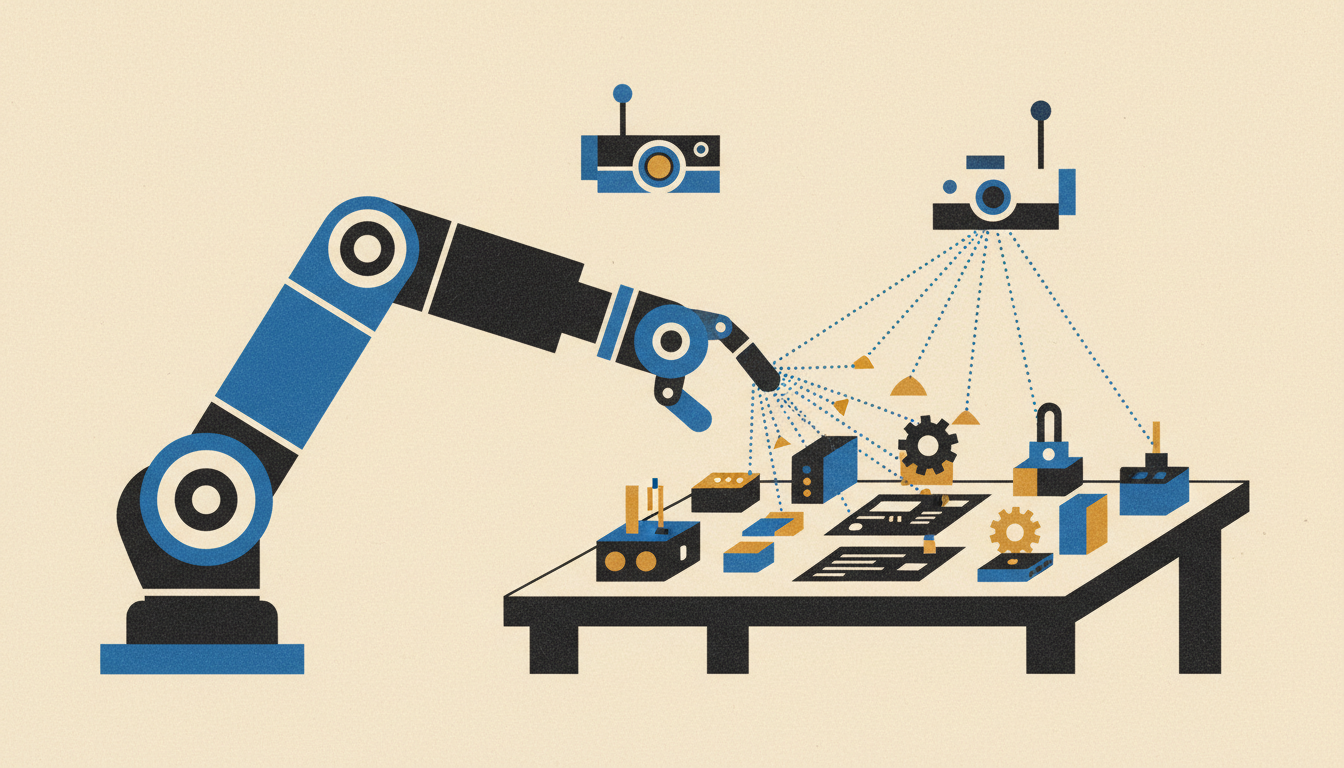
The product decision arrives before the robot does: when an AI system can help orchestrate physical hardware, the product is no longer only the model or the machine. It is the relationship between perception, judgment, movement, and failure. That shifts ownership toward the robotics PM, who must now decide what the system is allowed to notice, infer, ask, and do in a world where a bad answer can become a bad motion.
On September 5, an Automate report described Google DeepMind’s push to extend Gemini into physical AI and robotics integration, expanding agent capabilities into real-world hardware orchestration. The evidence is narrow, and nobody outside the lab can yet say how broad the eventual product surface will be. The strategic direction is clear enough, though: software intelligence is being positioned to coordinate with machines, not merely respond on a screen.
For product teams, that makes the old boundary between “AI feature” and “robotics feature” less useful. A model may still generate the plan, but the product determines which sensors inform it, which actions are executable, which movements require confirmation, and what happens when the system’s view of the room is incomplete. Those are not implementation details to be settled after the roadmap. They are the roadmap.
The body becomes an interface
Physical agent orchestration sounds abstract until you picture an ordinary handoff. A system receives a goal, reads information from a machine, decides what should happen next, and sends an instruction back into hardware. The product must hold that loop together even when the environment changes between one step and the next. A box is not where the camera expected it to be. A person enters the work area. A gripper does not close as planned. The system needs a way to notice the mismatch before the next instruction compounds it.
That is why sensor fusion, the combination of signals from different sensors into a more useful picture of the world, becomes a product concern rather than a specialist term. The PM does not need to design the camera or force sensor, but must decide what evidence counts when those inputs disagree. If one sensor says an object is present and another suggests the grasp is unstable, does the system continue, slow down, ask for help, or stop? A clean interface cannot hide that choice. It can only make the choice visible and usable.
The important change is not that a model can be connected to a robot. Teams have been connecting software to machines for years. The change is that a broadly capable agent may sit closer to the center of the loop, interpreting a goal and coordinating several physical actions instead of executing one narrowly defined command. That creates a larger product surface, and with it a larger burden of definition. “Move the item” is not a requirement until the team has agreed what counts as the item, where it may be moved, how much force is acceptable, and what the system should do when the instruction is ambiguous.
In physical AI, the failure state is part of the user experience.
A robotics roadmap that still treats safety as a final validation phase is therefore incomplete. Safety validation must begin when the team chooses the task, not when the first prototype is ready for a demonstration. The PM should be able to name the conditions under which an agent may act without approval, the conditions that require a pause, and the evidence needed to resume. That may sound like governance, but the practical issue is product behavior: users need to know whether the machine is thinking, waiting, retrying, or refusing.
Decisions at the edge
This is where physical systems differ from software agents in a way that matters to prioritization. In software, a wrong action may be reversible through an undo button, a corrected record, or a second request. In a physical setting, the same uncertainty can damage an object, interrupt a workflow, or put a person too close to a moving mechanism. The PM cannot assume that a later model improvement will erase the cost of an earlier product decision.
The first implication is that discovery must include the environment, not just the user’s stated goal. A warehouse task, a household task, and a laboratory task may all be described as “pick and place,” but the meaningful requirements live in the surroundings: who shares the space, how predictable the objects are, what visibility is available, and what kinds of mistakes are tolerable. The evidence does not tell us which environments DeepMind is targeting, so it would be premature to infer a market or a launch sequence. It does tell us that product teams should stop treating the physical setting as a wrapper around the model.
The second implication is that the roadmap needs explicit work for uncertainty. That can mean better sensing, clearer operator controls, narrower permissions, or a handoff to a person. It can also mean declining a task altogether. A useful product brief should state not only the intended action but the system’s stopping behavior, because a robot that stops safely is often more valuable than one that completes a narrow benchmark and behaves badly when conditions drift.
This is not an argument for putting a PM in charge of every technical choice. It is an argument for making the technical choices legible to product. Sensor coverage affects which promises the product can make. Actuator limits affect which workflows can be sold. Recovery behavior affects trust and operating cost. Validation results affect whether a feature is ready for a controlled environment, a supervised one, or no environment at all. If those dependencies live only in engineering notes, the roadmap is pretending to be simpler than the product.
Orchestration needs a contract
The practical response is to define a contract between the agent and the hardware. The contract should make clear what the agent can request, what the machine can actually perform, and what evidence must accompany a high-consequence action. For a PM, this is less about writing an elaborate protocol than about refusing vague capability language. “The agent controls the robot” hides too much. “The agent can request a grasp within these limits, after these checks, with this recovery path” is something a team can test and a customer can understand.
That contract also changes how teams measure progress. A demo that completes a task once may show possibility, but it does not tell a PM whether the system can handle altered lighting, an obstructed view, a delayed sensor, or a user who changes the goal halfway through. The exact evaluation plan will depend on the hardware and setting, and the available reporting does not provide those details. The product principle is still firm: measure the handoffs and the recoveries, not only the successful final motion.
There is a counterpoint worth keeping. The phrase “physical AI” can invite teams to redraw their organizations around a future capability before they know whether it works reliably enough for customers. Robotics remains constrained by the physical world, and a compelling orchestration layer does not remove the need for dependable hardware, careful operating procedures, or domain expertise. Product leaders should resist turning DeepMind’s direction into permission to add an agent to every machine. The right question is not whether a model can be connected, but whether the connection creates a safer, more useful product than a narrower and more predictable system would.
Still, waiting for certainty is not a strategy. Once software can coordinate physical actions, the decisions that used to sit in separate backlogs begin to interact. A perception improvement may expand the task scope. A new action policy may require a different approval flow. A safety restriction may change the value proposition. The PM’s job is to hold those consequences together early enough that the team can choose a product, rather than discover one accidentally through integration.
The immediate work for robotics and hardware teams is therefore concrete. Put orchestration into product requirements. Document which sensor inputs are trusted for which decisions. Define the human handoff before the autonomous path. Treat safety validation as an acceptance condition for the experience, not a gate at the end of development. And when a system cannot explain enough of its physical state to act safely, make stopping a supported outcome rather than a failure hidden from the user.
DeepMind’s Gemini push does not prove that general-purpose agents are ready to run broad physical workflows. The reporting does not establish that, and responsible teams should not pretend otherwise. It does establish a direction that product leaders can act on now: the intelligence layer and the machine layer are being designed closer together. Your next roadmap review should ask a harder question than whether the model is capable. Ask what the product will do when the world disagrees with it, and whether you have designed that moment as carefully as the happy path.