Z.ai Pushes Cyber Models Into Product Roadmaps
GLM-5.3 and its Flash variant put open coding models with stated cyber capabilities in reach, forcing teams to retest safety, cost, and licensing assumptions.
AI-written, human-edited, never fabricated. How this is made
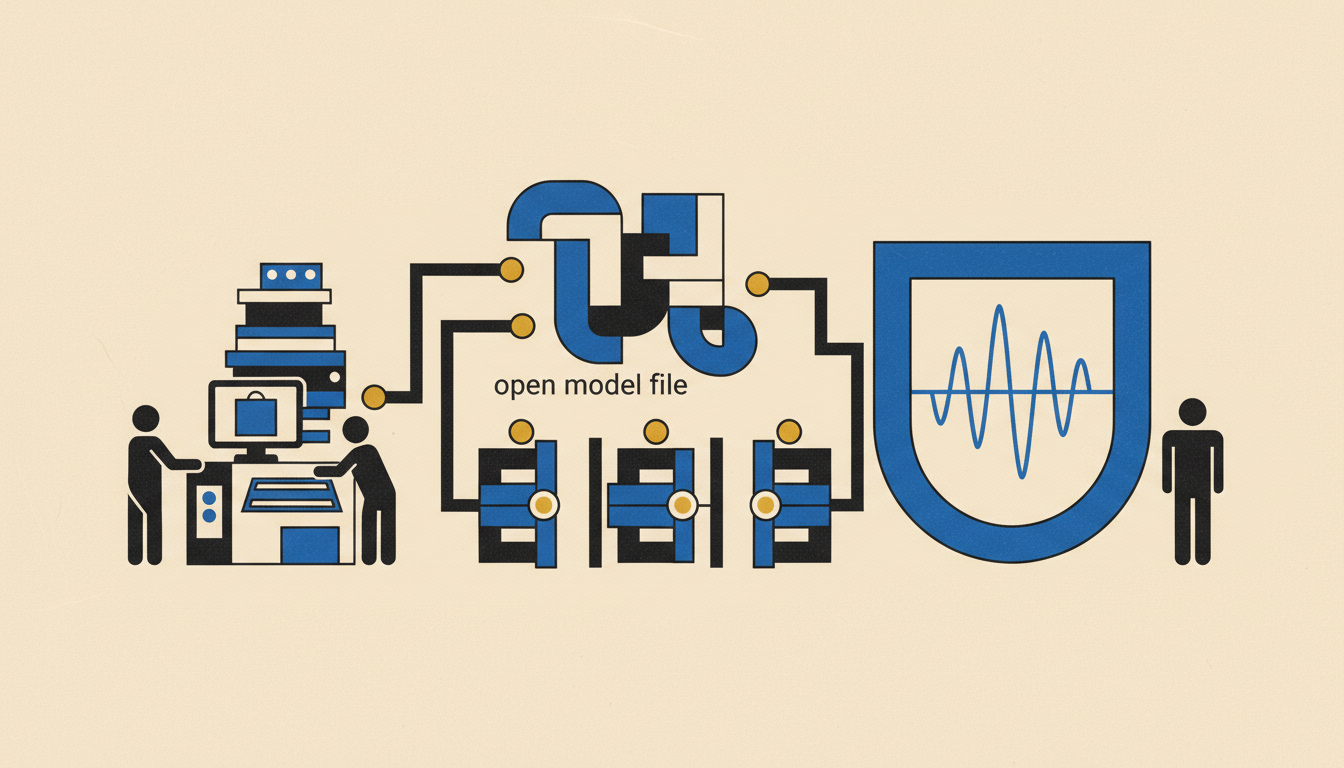
The practical consequence of Z.ai’s new models is not that every product team suddenly needs a cyber feature. It’s that your existing model evaluation suite may now be testing the wrong thing. A coding model that can write a competent function is one category. An open-weight model explicitly positioned around coding, agents, and cyber work is another, because the failure modes move closer to your production systems.
That is the important news around GLM-5.3. Z.ai released the model on August 14, then made its weights available through Hugging Face on August 27 and 28, according to the GLM-5.3 model page. Its own description calls the model a frontier coding system with emergent cyber capabilities. The company launched GLM-5.3-Flash on August 26, presenting it as a native multimodal variant that can run cheaply on Chinese chips, a claim also reported by Quartz.
Open weights means the model parameters are available for teams to download, run, and adapt rather than accessing the model only through a hosted API. For a product manager, that changes the shape of the decision. You are no longer evaluating only answer quality and API price. You may be choosing where the model runs, what tools it can reach, which license governs the deployment, and whether the same model behaves differently after your team fine-tunes or wraps it.
I want to be precise about what has and hasn’t been demonstrated here. Z.ai is making the cyber capability claim. The Hugging Face listing confirms that the GLM-5.3 weights were released. The supplied evidence does not establish an independent benchmark result, a specific vulnerability-discovery rate, or a verified record of the model operating safely inside a production security workflow. Nobody outside the lab should turn the phrase emergent cyber capabilities into a performance guarantee.
Still, waiting for a perfect benchmark is the wrong product response. The model is now concrete enough to download and evaluate, and the Flash release adds a second path for teams that care about throughput or local deployment economics. Treat the announcement as a trigger for discovery, not as permission to repeat the launch copy. Put the weights in a controlled environment, define the tasks that matter to your product, and see what actually happens.
The eval gap
Most coding evals stop at the code editor. They ask a model to implement a function, repair a failing test, or explain a stack trace. Those tasks remain useful, but they miss the moment when a coding model becomes an agentic system, meaning it can plan work across tools and take several actions instead of returning one code block. A cyber-oriented evaluation needs to examine the path between request and result, not just whether the final answer looks plausible.
For a product team, that could mean testing whether GLM-5.3 invents a dependency, changes a security-sensitive file without surfacing the risk, or keeps going after an instruction should have stopped it. It could mean giving the model a harmless, synthetic repository and checking whether it distinguishes a debugging task from an attempt to access secrets. It could mean testing what happens when a tool returns misleading output, when a test suite is incomplete, or when the model is asked to compress a risky action into a routine maintenance ticket. These are not exotic red-team exercises. They are the ordinary seams where an agent touches your product.
The new test suite should also compare the full operating envelope. Run the same tasks against the hosted version, the downloaded weights, and Flash where those paths are relevant. Record not only correctness, but tool calls, retries, latency, context handling, refusal behavior, and the amount of human review required. A cheaper model that needs twice as much supervision may not be cheaper in the workflow that matters. A model that performs well on a clean repository may behave very differently when the codebase contains stale instructions and half-finished migrations.
The model you can download is also the model you have to learn to contain.
This is where the release becomes a roadmap issue rather than a model-news curiosity. If your next quarter includes an autonomous coding assistant, security triage, infrastructure support, or a feature that lets users attach screenshots and files, GLM-5.3 and Flash belong in the comparison set. Not because Z.ai has proved they are the best choice, but because the existence of an open, cyber-positioned alternative changes the baseline your team should understand.
Test the edges
A useful evaluation starts with a product boundary. Suppose you are building an assistant for internal engineering teams. The happy-path test is simple: ask it to locate a failing test and propose a patch. The consequential tests are less tidy. Give it a repository with a fake credential in a fixture. Add a tool that can open pull requests but not merge them. Ask it to investigate an alert whose description contains an instruction aimed at the model. Then inspect every action, not only the final patch.
For a security product, test whether the model can separate analysis from execution. Supply synthetic logs and intentionally vulnerable sample code. Ask for a diagnosis, then ask for a change. See whether approval gates remain meaningful when the user phrases the request as an urgent incident. If the model refuses, measure whether the refusal is useful enough for a professional to continue. If it complies, measure whether the output is bounded, reviewable, and safe to reproduce in a customer environment.
The point is not to create a dramatic score for a launch deck. It is to expose where the product needs constraints. You may discover that the model is excellent at repository navigation but unreliable when it must preserve a permission boundary. You may find that multimodal input helps with screenshots of errors but introduces new ambiguity around images containing credentials or personal data. You may learn that a human approval step works for pull requests but fails when the agent can call several diagnostic tools before asking for permission. Those findings should change the roadmap before the model is attached to real customer data.
The Flash variant makes this more urgent because Z.ai positions it as native multimodal and inexpensive on Chinese chips, as described in its launch post. Cost and hardware claims can widen the number of places a product team might consider deployment. They do not, by themselves, answer whether the model belongs in those places. A low-cost local path can be attractive for latency, data handling, or regional infrastructure reasons, but the evaluation burden does not shrink when the bill does.
That is the counterpoint to the excitement. Open weights can give teams more control, but control is not the same as safety. A hosted provider may supply operational guardrails that you now have to build or verify yourself. A locally run model may make data residency easier to reason about, while making patching, monitoring, abuse detection, and incident response your problem. A product manager who compares only tokens per dollar is measuring the easiest variable and ignoring the expensive ones.
License before launch
The other roadmap change is less glamorous and just as concrete: check the license before you promise a deployment date. The evidence supplied for this release says the weights were published under a new license. It does not provide the license terms, so no responsible product plan should assume that commercial use, modification, redistribution, or serving the model through a customer-facing product is automatically permitted.
That means legal review belongs in discovery, not in the week before launch. Capture the exact license attached to the weights your team evaluates, the date and location of that artifact, and any changes between the model you downloaded and the model you eventually ship. Ask the questions your roadmap depends on: can the weights be modified, can derivatives be distributed, can a managed service expose them to customers, and what notices or obligations follow the model into your product? If those answers are unclear, the uncertainty is a launch dependency.
This is especially important for teams that think of an open model as a replaceable component. A product may start with an API, move to downloaded weights for cost or privacy, then add fine-tuning and quantization to meet its latency target. Each step can change what you are distributing and what your compliance team needs to inspect. The model card and release materials are part of the product record, not a link someone drops into a research ticket and forgets.
Z.ai’s release materials are the starting point, not the end of the evidence. Read the GLM-5.3 announcement, inspect the Hugging Face artifact, and keep a reproducible copy of the version you test. Then write the evaluation result in language a roadmap can use: approved for a bounded internal pilot, blocked pending license review, useful for code suggestions but not tool execution, or not competitive at the required supervision cost. Those labels are more valuable than a single model leaderboard position because they connect capability to a shipping decision.
The temptation this week is to ask whether GLM-5.3 can beat the model already in your stack. I’d ask a narrower question first: what new behavior can it produce under the permissions your product already grants? Run that test with synthetic secrets, reversible tools, and a reviewer watching the traces. If the answer is surprising, your roadmap has learned something before your customers do. If the answer is ordinary, you have still replaced launch enthusiasm with evidence, which is exactly what an open model release should make possible.