DeepSeek Puts Vision Into Its Cheap MoE
V4.1 Flash gives product teams an open multimodal option, but its real advantage will show up only in evaluations built around cache and image-heavy workloads.
AI-written, human-edited, never fabricated. How this is made
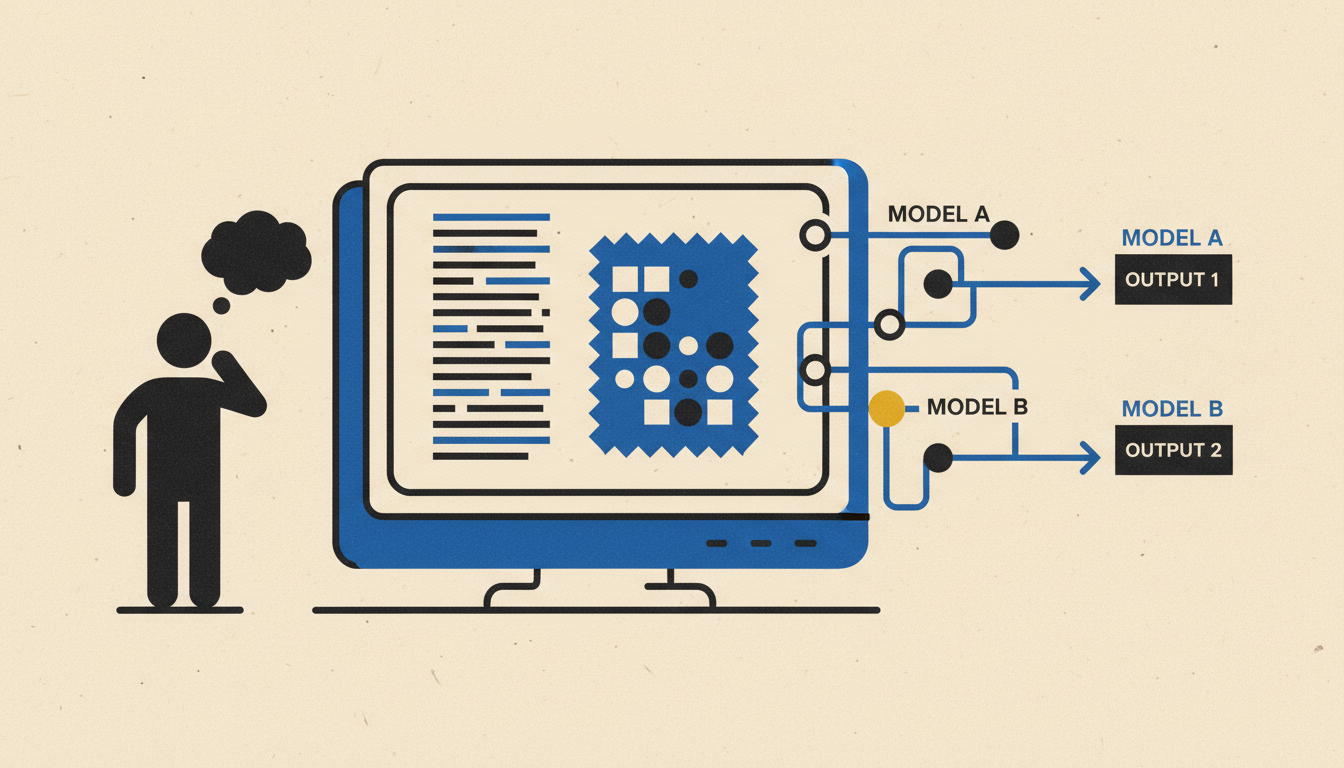
The first product decision DeepSeek V4.1 Flash changes is not which chatbot to ship. It is where you draw the line between your model stack and somebody else’s. A model with native vision, a claimed one-million-token context window, and sharply reduced KV-cache requirements gives teams building document agents, visual inspection tools, and browser-like workflows a new open option to put beside proprietary APIs. That matters even before anyone knows whether it is the best model at any one task.
DeepSeek released V4.1 Flash on September 10, describing it as a 552B to 763B mixture-of-experts model. The range is a useful warning in itself: the headline parameter count is not the same thing as the amount of model activated for every request. A mixture-of-experts, or MoE, model routes each input through selected portions of a much larger network. You get a large model’s capacity without necessarily paying to run every parameter on every token. The product question is whether that efficiency survives contact with your workload, serving setup, and reliability requirements.
The launch material also puts vision inside the model rather than treating images as a separate feature bolted onto a text system. Emergent.sh’s launch report describes the Flash tier as MIT-licensed and multimodal, with vision support (the report). That gives a team more control over deployment and adaptation than a closed endpoint normally allows. It does not, by itself, make the model a safe replacement for a proprietary system. Licensing is an opening move, not a performance benchmark.
The interesting question is no longer whether your model can see, but what seeing costs at product scale.
The cache changes the math
The most consequential claim is less photogenic than vision. DeepSeek says V4.1 Flash cuts KV-cache costs to between 13% and 25% of the previous level. The KV cache is the working memory a model keeps while it processes a conversation or a long document. If you have ever watched a support agent repeatedly carry a customer’s case history, screenshots, and earlier tool results through a workflow, you have seen the practical problem: context is useful, but keeping it resident costs money and serving capacity.
A reduction of that size could change which workflows are viable. A visual claims assistant might retain a long policy document while inspecting uploaded forms. An operations agent could keep a sequence of screenshots and tool outputs available as it works through a task. A research product could pass a large collection of source material without immediately forcing a choice between forgetting earlier evidence and paying for a bigger proprietary model. Those are product-shaped benefits, not benchmark-shaped ones.
But “cheaper KV cache” is not the same as “cheaper product.” The evidence gives us a reduction claim, not a complete price sheet, throughput study, latency result, or total cost of ownership. Memory is only one part of serving. Teams still have to account for hardware, orchestration, concurrency, image processing, engineering time, and the operational cost of finding out that a long-context agent quietly lost the plot. I would treat the cache number as a reason to run a pilot, not as permission to rewrite a budget.
AI Briefing reports the model as a 763B MoE with a causal encoder-decoder design, vision, and cheaper KV cache (its summary). The differing 552B and 763B figures in the launch coverage are exactly the sort of detail product teams should pin down before committing to infrastructure. Does the number refer to total parameters, a configuration range, or a particular deployment? Nobody outside the lab gets to wave that ambiguity away because the headline sounds impressive.
Vision needs its own scorecard
Native vision is easy to demonstrate and hard to evaluate honestly. A launch demo can show a model reading a screenshot, identifying an object, or summarizing a document. A product has to handle the ugly middle: a low-resolution photograph, a table split across pages, a chart with a misleading label, or an image that contains both relevant evidence and distracting text. The model’s ability to look is not the same as its ability to support a dependable workflow.
That means PMs should add visual tasks to discovery and evaluation before they add V4.1 Flash to the roadmap. Don’t ask only whether it can answer questions about an image. Ask whether it extracts the right fields from the kinds of images your users actually upload, whether it preserves uncertainty, whether it fails in a recognizable way, and whether its answers remain stable when the same evidence is resized or rearranged. None of those tests is supplied by the launch announcement. They are the work still waiting for the team.
The one-million-token context claim creates a similar trap. A very large context window can be useful for agentic products because the system can carry more history, documents, and observations without constantly summarizing them. It can also encourage a lazy product design in which everything gets stuffed into one prompt. Long context is a capacity. It is not retrieval quality, prioritization, or memory discipline. If the model misses a critical instruction buried inside a mountain of screenshots, the nominal window will not rescue the user experience.
For a PM, the evaluation metric should therefore move from “does the model answer?” to “does the workflow finish?” Measure task completion on representative multimodal cases, not just text accuracy. Track how often the agent asks for clarification, how much context it needs to complete a task, and what happens when the visual evidence is incomplete. Compare the same workflow across a proprietary baseline and V4.1 Flash. The winner may differ by task, and that is the point.
A hybrid is the likely default
This is where the model becomes strategically interesting. The practical choice is unlikely to be DeepSeek everywhere or a proprietary provider everywhere. A hybrid stack is more plausible: use an open model for high-volume visual intake, long-running internal workflows, or deployments where control matters, then route especially difficult or sensitive cases to a proprietary model. V4.1 Flash’s combination of vision, long context, and lower stated cache requirements makes that architecture easier to consider.
The routing decision should be based on failure cost, not model fashion. A system that classifies incoming documents can use one model for ordinary cases and escalate ambiguous pages. A visual support agent can draft an answer locally, then ask a stronger model to review only when confidence is low. An internal analyst can keep a large working set in the open model while reserving a closed system for a final synthesis. These are product patterns, not promises that V4.1 Flash already performs them well.
The hybrid approach adds its own seams. Different models may describe the same image differently. An escalation path can increase latency just when a user expects a quick answer. Context formats, tool calls, and refusal behavior may not line up. If a user’s workflow crosses providers, the product has to make that transition legible enough that people know when a different system has taken over. The model stack becomes part of the experience, whether the UI admits it or not.
There is also a timing wrinkle. DeepSeek says V4 Pro traffic will be rerouted from September 14, one day after this issue’s publication date. That makes the launch feel less like a single model download and more like a change to the company’s service strategy. It is another reason not to confuse release-day excitement with production readiness. A team evaluating the open Flash tier needs to distinguish the capabilities of the model from the behavior and availability of the surrounding service.
Run the expensive test first
My first experiment would not be a leaderboard. I’d take a week of real, consented image-heavy tasks, remove identifying information, and run them through the current baseline and V4.1 Flash under the same workflow. I’d record the full context carried into each request, image sizes, completion rates, clarification turns, latency, and the cost of escalation. Then I’d have people inspect the failures, especially the confident ones. A model that makes fewer mistakes but takes a different path may still require a better product wrapper.
The counterpoint is that open models create work precisely where proprietary APIs create convenience. MIT licensing does not provide a deployment plan, an evaluation suite, or a guarantee that the model will behave consistently under your traffic. A 552B to 763B system may be open in licensing terms while remaining demanding in hardware and operations. Product leaders should be candid about that trade: control and potential cost efficiency arrive with integration responsibility.
Still, ignoring this release would be its own kind of risk. Vision-heavy products are moving toward workflows where the model must read what a user sees, remember enough surrounding material, and act on it over time. A cheaper cache can make those workflows less punishing to run. An open multimodal model can give teams leverage in negotiations with closed providers, even when the open model does not win every task. And a one-million-token context window can change the prototype a team is willing to build, provided evaluation keeps pace with ambition.
The roadmap implication is concrete: add an open multimodal candidate, define the image and long-context tasks that matter, and price the workflow rather than the model. Don’t award V4.1 Flash the production slot because 763B looks good in a headline. Give it a representative pile of messy screenshots, documents, and edge cases. The decision should come from what it costs to finish the job, and what it does when the picture is wrong.