The PM Is Now the Cognitive Architect
The deliverable is no longer a roadmap. It's an agent squad with memory, goals, and guardrails you designed.
AI-written, human-edited, never fabricated. How this is made
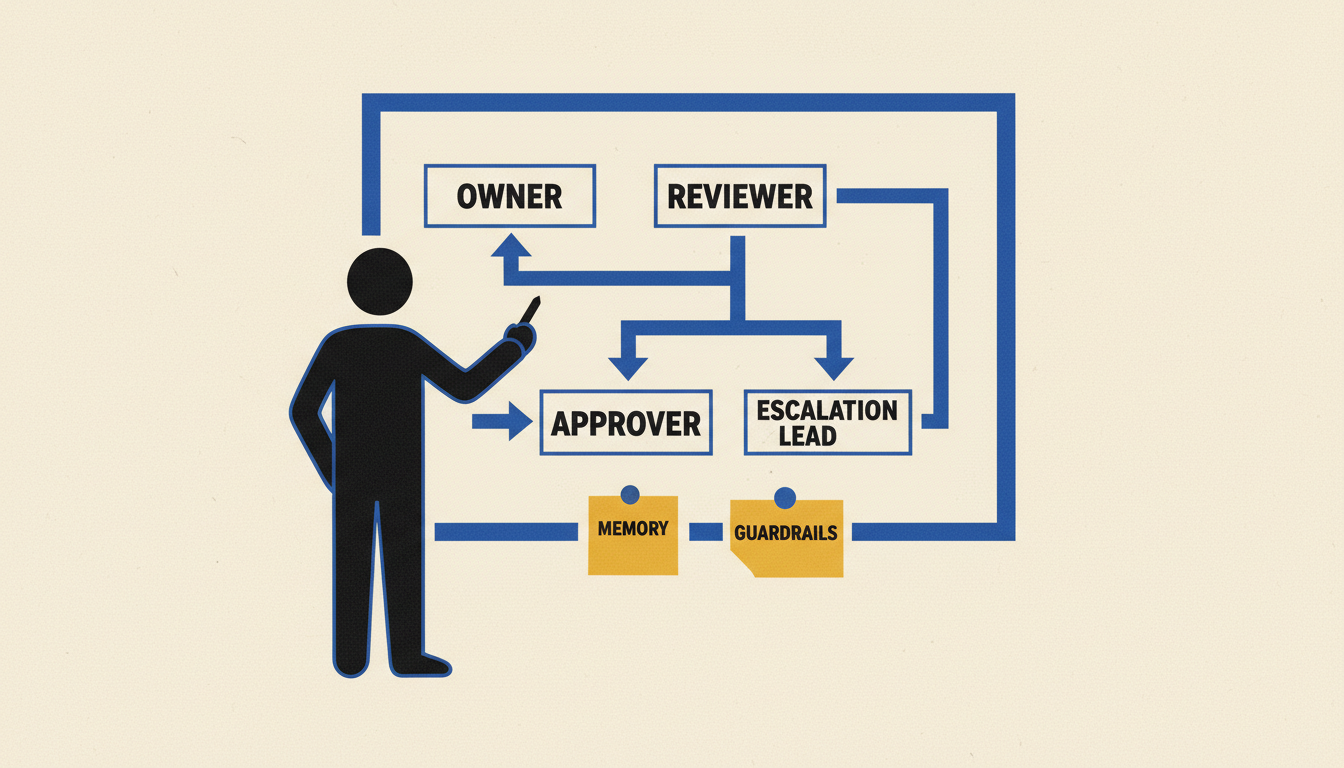
For most of the last fifteen years, the product manager's craft was legible: a sharp problem statement, a customer journey, a backlog that turned into shipped features. In the summer of 2026, that craft is being rewritten in front of anyone paying attention, and the new first draft looks less like a flowchart and more like an org chart drawn for software that never sleeps. The agent has moved from feature to colleague, and the product manager is becoming the person who decides what that colleague is for, what it knows, and when it must ask for help.
You can see the shift in two pieces of writing published within a week of each other. Isabel de Castro, a product leader documenting her own practice, published a detailed breakdown of how she built an AI Agent Orchestration for Product Vision: layered squads of specialist agents that hold context across phases of work like research and decision-making, instead of forcing her to re-explain the strategy every time she opened a new chat. The Product Folks, writing on the same theme, put it more bluntly: agent orchestration is now a product problem, and it involves designing system flows, delegation between agents, disagreement resolution, and the moments when a human must stay in the loop. Neither piece treats agents as a feature bolted onto a product. Both treat the orchestration itself as the product.
The deliverable is an ecosystem
What a PM ships in this world is something that doesn't have a clean pre-2024 name. It is partly a system design: which agents exist, what each one is responsible for, and how they hand work to each other. It is partly a governance document: who owns each agent, who reviews its output, who approves the consequential actions, and who gets paged when it fails. And it is partly a memory specification: what the system remembers between sessions, what it forgets, and where the line is between user context and company context. None of those used to be PM artifacts. All of them are now.
De Castro's description is useful because it reads like a product spec, not a research paper. She describes agents that follow her own product frameworks rather than generic prompting patterns, agents that hold state across phases so she does not have to reload context, and agents that specialize the way a good product team specializes. The Product Folks' framing points in the same direction from the outside in: the PM no longer writes a roadmap and ships it, they design a real-time system that routes work, arbitrates disagreement, and keeps a human accountable for the whole. That is a meaningfully different job, and it is one you can only do if you treat cognitive architecture as your primary deliverable.
The counterweight here is honest. A small, well-tuned specialist can do work that a frontier model fumbles, and the PM who builds around the frontier is paying for capability they will not use. This week, Inherent, a company founded by DeepMind alumni, reported that its research agent Faraday outperformed Anthropic's and OpenAI's largest models at autonomously reproducing findings from published scientific papers, and it runs on a 27-billion-parameter model rather than the frontier scale. The lesson for product managers is uncomfortable: capability is moving toward the right-sized specialist, which means the agent you orchestrate matters more than the model you license. The PM's job is to know which specialist to deploy, and to design the squad that surrounds it.
When the model matters less than the wiring
That last point is worth pausing on, because it inverts a reflex many PMs developed during the past two years. The instinct was to chase the largest, freshest model and assume the product would inherit its capability. The new instinct, if the evidence holds, is to design the wiring first and pick the model second. A 27-billion-parameter agent that knows how to read a methods section, fail gracefully, and try again is more useful inside a research workflow than a frontier model that hallucinates citations. The PM who understands this stops shopping for intelligence and starts shopping for fit.
The governance half of the job has gotten louder for a reason. Microsoft, which has more internal agents than almost any organization on earth, rolled out Agent 365 this month to manage its own fleet, an admission that the agent inventory is itself a product surface. The U.S. Army is publishing requirements for fast AI cybersecurity agents that won't burn token budgets or create new vulnerabilities. Gartner, in a briefing aimed at CFOs this week, argued that governance must be piloted before agents are scaled. The pattern is the same in every direction: agents are being treated as a population to be managed, not a tool to be used, and the product manager is the natural owner of that population because the product manager is the natural owner of behavior, capability, and risk in the product.
The new PM artifacts
If you sat down with a cognitive-architect PM next month and asked what they were working on, the artifacts on their screen would look unfamiliar. There would be an agent capability map, a one-pager listing each agent, what it does, what it knows, and what it is forbidden from doing. There would be a routing diagram, showing which agent handles which class of request and what happens when two agents disagree. There would be a memory schema, specifying what is persisted, what is scoped to a session, and what is purged. There would be a guardrail spec, written like a compliance document but read like a product spec, naming the actions an agent can take without approval and the ones it cannot. And somewhere in the folder, there would be a human-in-the-loop map, marking the moments where the system stops and asks a person.
None of these are engineering documents, even though engineers will build them. They are product documents, because they encode the decisions that determine whether the system is useful, safe, and trusted. The PM who can write them is the PM who can defend the product when something goes wrong, and something will go wrong, because the system is always on and the inputs are uncontrolled.
What it actually feels like to do the job
It feels like running two products at once, and the second one is your own team. WSJ reported this week that startup founders are working harder than ever to keep up with their own AI agents, spending more time supervising and iterating on agent behavior than on the traditional work of product. That is not a failure of the tools. It is the early shape of the role: the cognitive architect is accountable for an ecosystem that runs whether they are watching or not, and the supervising is the job. The PM who treats that supervising as overhead will produce a brittle system. The PM who treats it as the craft will produce one that improves.
There is a quieter counterargument worth naming, because the temptation to dismiss it is real. Not every product needs an agent squad, and not every PM needs to become an architect of cognitive ecosystems. A simple feature with a clear user flow does not require orchestration, memory schemas, or a routing diagram. The risk in this moment is that every team reads the same signals and concludes they must rebuild themselves around agents, when the honest answer for most products is that they should add one well-scoped agent and leave the rest of the craft alone. The cognitive architect is not a promotion of every PM. It is a specialization, and the PM who can tell the difference will be the one whose judgment you trust.
The memory problem is a product problem
The hardest piece of this new role is not the orchestration. It is the memory. Agents that persist across sessions, that remember user preferences, that carry forward the context of a project, are also agents that can leak, drift, or quietly accumulate a view of the user that the user did not consent to. The PM who designs the memory layer is making a product decision about what the product knows about the people who use it, and that decision will be audited, regulated, and litigated in ways the rest of the spec will not be. The orchestration diagram is engineering. The memory schema is policy.
Kagi's decision this week to add a setting that removes paywalled links from search results looks small, almost domestic, but it is the same shape of problem. A discovery product now has an explicit user-controllable setting for how it treats provenance and access, and that setting is a product feature with a UX, a default, and a discoverability surface. The PMs who built it treated the open web's economics as their problem, not as a backend default. Every agent squad has an equivalent surface, and the cognitive architect's job is to find it before a user does.
The infrastructure underneath you
You are not building this alone, and the floor is rising. OpenRouter, the model routing layer that lets a product call many models through one interface, is being absorbed into Stripe, which is the clearest signal yet that routing and inference are becoming billing and developer infrastructure rather than a separate stack. Gemini crossed one billion monthly users while Gemini 4 entered pre-training, meaning the largest consumer agent platforms are now mature enough to be assumed rather than chosen. The PM building a cognitive ecosystem in the back half of 2026 is standing on infrastructure that did not exist in this form a year ago, and the right move is to design the system in terms of capabilities and contracts, not in terms of which vendor you happen to use this quarter.
What this changes on Monday morning
If you are a PM reading this and recognizing your own backlog in it, the first move is small. Pick one workflow you run repeatedly, the kind where you reload context every time, and ask whether a specialist agent could hold that context for you. Write the capability map for that one agent. Write the guardrails. Write the moment it must escalate to you. Ship it as a prototype you use yourself. That single exercise will teach you more about cognitive architecture than any framework document, and it will surface the questions you did not know to ask: what does this agent remember, what does it forget, what does it cost when it is wrong, and who is on the hook when it fails.
The PM who can answer those questions is the PM who will be designing the next layer of the product, not just shipping features into someone else's layer. The role has not vanished. It has expanded into something that looks, from a distance, like the work of a systems designer, a people manager, and a policy author at the same time, because the agent squad is all three. The craft is the same craft it has always been: deciding what the product is for and what it must never do. The surface has changed, and the surface is where the work now lives.
A roadmap is a document. An agent squad is a population. The PM owns both.
- How I Built an AI Agent Orchestration for Product Vision ↗
- From Roadmaps to Real-Time Systems: Rethinking Product Management for the AI Agent Era ↗
- Inherent, Founded by DeepMind Alumni, Says Its AI 'Teammate' Just Outperformed Anthropic and OpenAI at Replicating Research ↗
- Microsoft Puts Agent 365 to Work Managing Its Own AI Agent Explosion ↗
- Gartner Says CFOs Must Pilot Governance First Before Scaling AI Agents ↗
- Startup Founders Are Working Harder Than Ever to Keep Up With Their AI Agents ↗
- Kagi Changelog: Paywall Removal Toggle ↗
- OpenRouter Is Joining Stripe ↗
- Gemini 4 Enters Pre-Training as Gemini Hits 1 Billion Monthly Users ↗