Agent Org Charts Are a Product Decision Now
Naming every production agent's Owner, Reviewer, and Approver is now a product feature, not an IT chore.
AI-written, human-edited, never fabricated. How this is made
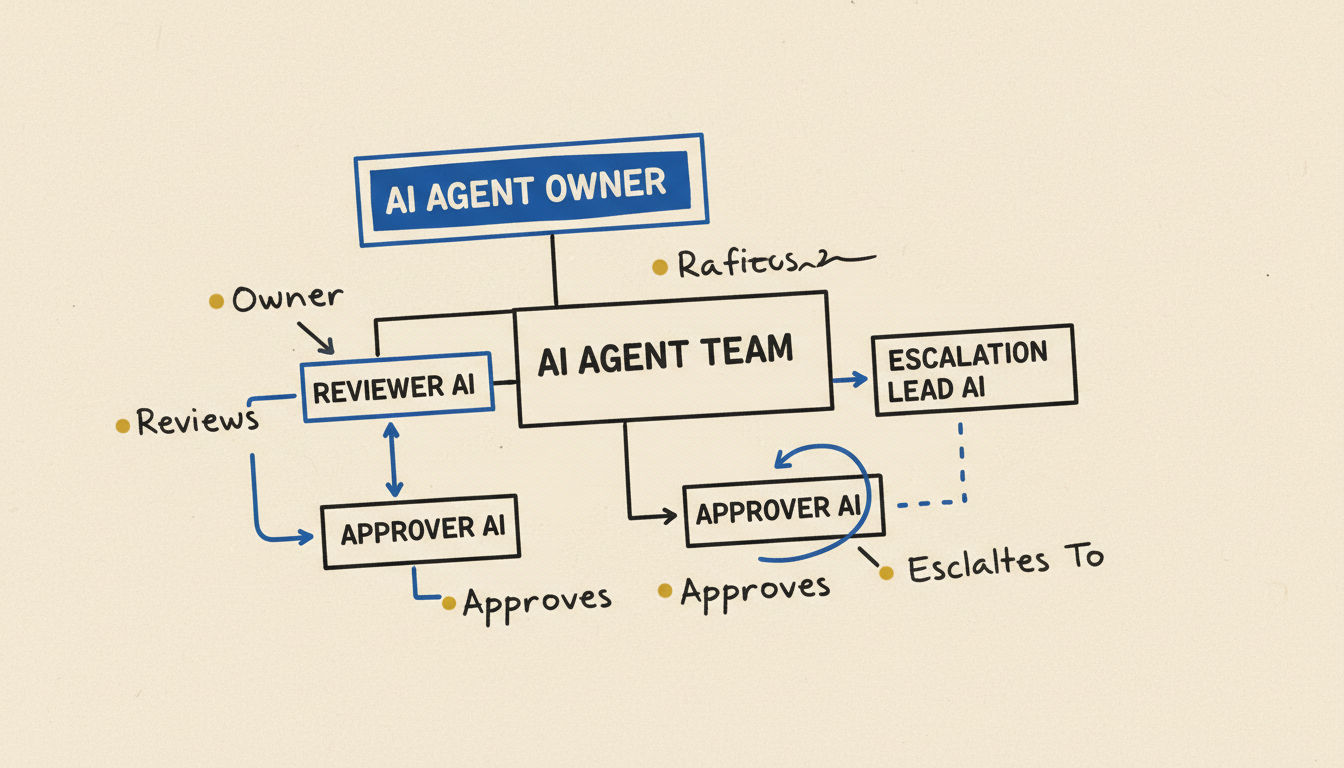
Last Tuesday, Dux Raymond Sy put the question bluntly: every AI agent that touches production needs an org chart. Not an org chart in the metaphorical sense, but a literal one, with a named Owner, a Reviewer, an Approver, and an Escalation Lead on the hook for whatever the agent does in the wild. Sy, who writes about enterprise AI for SiliconANGLE, drew a line most teams have been quietly blurring. Permissions tell an agent what it is allowed to do; accountability tells a human who answers when it does the wrong thing. Those are two different problems, and only one of them has been getting any attention.
The organizations shipping serious agent fleets this summer are starting to treat the second problem like a product feature. They are mapping roles the way a startup maps its hiring plan, sitting down before launch and deciding, on purpose, who wakes up at 3 a.m. if the refunds agent starts issuing store credit for items no one bought. That is a workflow, a routing rule, and, in some cases, a piece of UI. It is also a roadmap decision. And it belongs to the PM.
Governance leaves IT and lands in the product spec
For two years the conventional answer to "who owns this agent?" was the IT team, the security team, or a hand-wavy "the platform owner." That answer is breaking in real time. Across the industry, the people most accountable for an agent's outcomes are the same people accountable for the feature it sits inside: the product manager.
Look at the structure James Park describes in his running tally of how 2026 companies are organizing agent teams. Three models are converging. Centralized puts every agent under one platform team, typically six to ten people including a dedicated AI platform PM. Embedded tucks agents into the product squads that own the feature, so the customer support agent lives with the support team and the pricing agent lives with pricing. Hybrid pairs a small central platform team with engineers embedded in each product squad. Hybrid is showing up most in companies that have been running agents long enough to have learned from their first production incidents.
What is striking about all three is that the PM is not adjacent to the agent's ownership chain; the PM is the one designing it. Whether the structure is centralized or embedded, someone has to write the document that says: this agent, this Owner, this Reviewer, this Approver, this Escalation Lead. That document is a product artifact, with a template, acceptance criteria, and a review meeting of its own.
The four names on the chart
Sy is specific about what those four roles actually do. The Owner is the person who can answer "what is this agent for, and is it still doing that?" The Reviewer checks outputs against that intent on a cadence: weekly for most customer-facing agents, daily for the riskier ones. The Approver sits in front of the highest-stakes actions, like the refund over a threshold, the account reinstatement, the access grant. The Escalation Lead is the human an end user can reach when the agent is wrong and cannot see it, which is more often than any vendor's demo suggests.
These are not job titles you can borrow from a RACI matrix. They are product behaviors. The PM who designs them has to ask questions that were never on the user-story template: at what dollar threshold does the Approver get paged? What does the Escalation Lead actually do when a user files an appeal, and is that flow built yet? What does the Reviewer look at on a Tuesday morning when the agent made eleven thousand decisions yesterday and nine of them look weird? Those questions have been hiding inside the model provider's console for eighteen months. They are coming out.
The org chart is the forcing function that separates the jobs easy to confuse.
What it actually feels like to own an agent
The honest version is that the people closest to this work are tired. The *Wall Street Journal* ran a piece this month on founders spending more time supervising their own agents than building their companies. The reporting is about startups, but the dynamic shows up at every scale. An agent does not phone home only when it does something clever; it phones home on every request, every failure, every escalation it could not resolve. Someone has to look.
Here is what it looks like in practice. An agent scoped to "summarize a support ticket and draft a reply for a human to send" has been quietly co-opted by a sales team tired of writing follow-ups. Nobody approved that use case. The agent is producing fluent, technically correct replies that miss the point entirely, because sales follow-ups are a different genre than support replies. The Reviewer is the person who caught it. The Owner is the person who constrained the prompt and revoked access. The Escalation Lead is the human a customer can reach when the agent marked a real issue resolved and it was not.
That is the job the PM signs up for when the org chart gets attached to the agent. It is not the glamorous part. It is the part where you find out the agent does things nobody planned for. The good news is the work is learnable. The bad news is it does not fit neatly under anyone else's job description, and the PM is the only person in the room with the customer context and the authority to ship a change.
The counterargument, honestly
There is a reasonable counterargument, and a PM should hear it before committing. Most agents in a typical SaaS product are not high-stakes enough to justify four named humans in the loop. Your "tag the support email" agent or your "summarize this PRD" agent probably do not need an Approver on call. They need a Reviewer who watches for drift and an Owner who knows when to retire them, and that is plenty. Park's data hints at the same instinct. Teams that adopt the embedded model often start by giving each squad one or two of the four roles and only promote agents to the full governance stack once they have caused an incident or crossed a risk threshold. The org chart, in other words, is a living document that grows with the agent's blast radius, closer to how good product teams have always written runbooks, and a sound starting point for most companies. The danger is treating the chart as optional from day one. Once an agent has shipped for a quarter without one, retrofitting the roles is a political fight. The PM who lands governance in the launch checklist is doing a job the company will thank them for eighteen months later.
Adjacent signals, the same direction
Look at what the platforms are doing this month, and the direction firms up. Microsoft is using its own *Agent 365* to inventory hundreds of thousands of internal agents, each with a risk rating and an owner of record. The U.S. Army's recent procurement language for AI cybersecurity agents is explicit that agents must not blow up token budgets or open vulnerabilities, which means someone is on the hook for both. Gartner is telling CFOs to pilot governance before scaling agents. Even the agent infrastructure layer is consolidating: OpenRouter joining *Stripe* this week turns model routing into a billing primitive, which has the side effect of making every agent's spend an attributable line item someone has to explain at quarter-end.
None of those platforms are doing the PM's job for them. They are making the job possible. The governance chart, the risk rating, the token budget, the invoice line: inputs to a product decision, and the decision still sits with the person who owns the road map.
What changes on Monday morning
If you are the PM whose team is about to ship the third or fourth agent into production, here is the practical version. Pull up a one-pager for each agent. Write four names on it: Owner, Reviewer, Approver, Escalation Lead. If two of those names are the same person, that is worth a sentence explaining why, because the chart is a forcing function for separating the jobs that are easy to confuse. Decide the threshold at which the Approver gets paged. Decide how the end user reaches the Escalation Lead. Decide what the Reviewer looks at every week. Do not pretend the answer is durable. It will change. That is fine. The point is that the chart exists, that it lives next to the agent's spec, and that the PM is the one updating it. The shift from bolting agents onto existing human structures to designing charts for agents from scratch is not glamorous, and it is not finished. The PMs who treat governance as a product feature instead of an IT chore are the ones who will ship agents their companies can actually defend.
The question for next quarter is not whether your fleet needs an org chart. It is whether yours is already written down.
- Why every AI agent needs an org chart ↗
- AI Agent Team Structure & Org Charts 2026 ↗
- Startup Founders Are Working Harder Than Ever to Keep Up With Their AI Agents ↗
- Microsoft Puts Agent 365 to Work Managing Its Own AI Agent Explosion ↗
- Army Wants Fast AI Cybersecurity Agents That Won't Run Up Costs, Create Vulnerabilities ↗
- Gartner Says CFOs Must Pilot Governance First Before Scaling AI Agents ↗
- OpenRouter is joining Stripe ↗