Apple Ships Siri’s Local Agent Beta
iOS 27 moves persistent agent design into the hardware roadmap, making silicon, privacy boundaries, and everyday orchestration one product decision.
AI-written, human-edited, never fabricated. How this is made
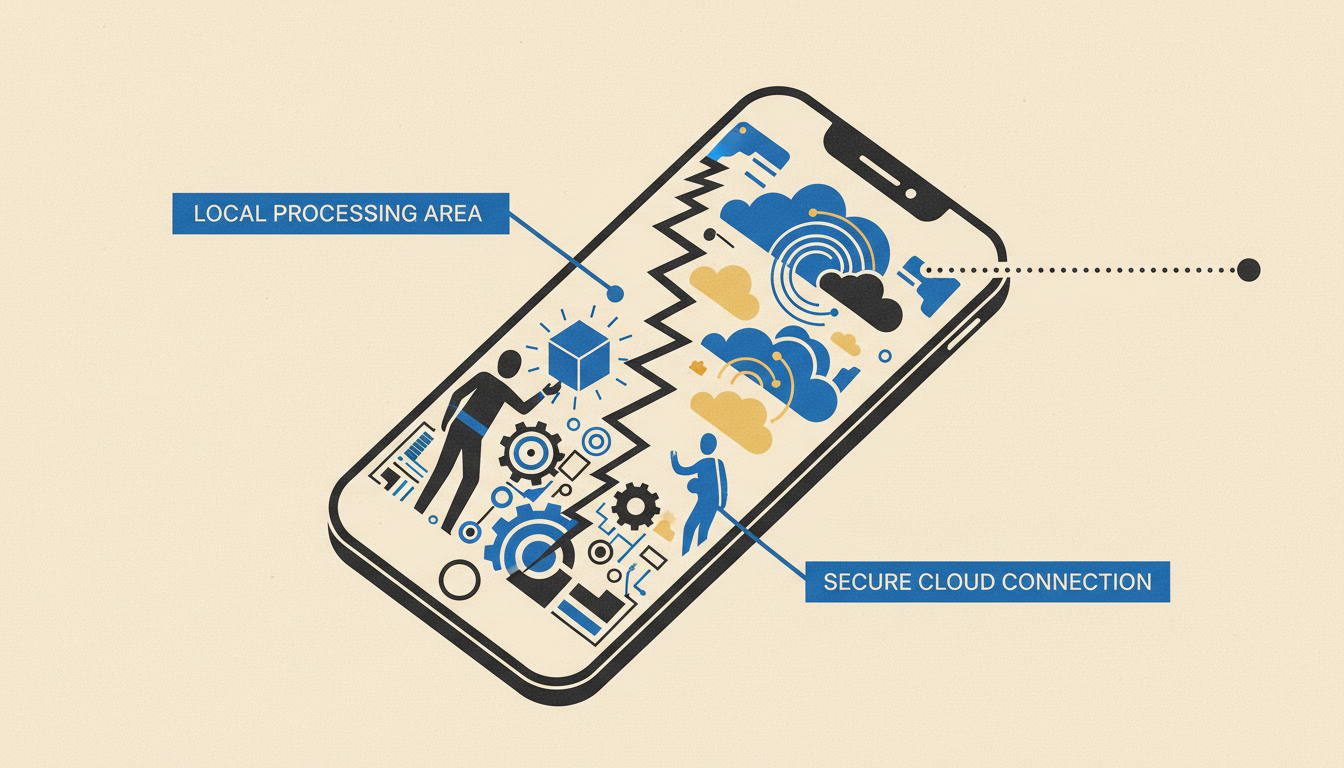
The mistake would be to treat iOS 27’s rebuilt Siri as a voice-interface update. The more useful reading is operational: Apple has made the device part of the agent team, and hardware PMs now own what happens between a user’s request, a model’s decision, and the action that follows.
Apple released iOS 27 on September 14, alongside iPadOS 27 and macOS 27, with an on-device Siri AI beta in English. The release combines on-device logic with Private Cloud Compute and Gemini integration, running on the new 2nm A20 chip, according to Apple’s announcement. That is a lot of plumbing in one sentence. For product teams, the important part is not any single component. It is the fact that the user experience now depends on how those components share responsibility.
A local agent is not merely a smaller model sitting on a phone. It is a product that can keep enough context, interpret a request, decide what work belongs on the device, and reach beyond the device when the experience requires it. The user does not want to know which piece handled the request. They want the right result without a privacy surprise, an awkward handoff, or a dead end when the device cannot do enough on its own. That makes the boundary between silicon and software visible in the product, even when the interface tries to hide it.
Silicon becomes a surface
For a hardware PM, this changes the brief. The chip is no longer only a performance target for applications to consume later. Its capabilities shape what the agent can attempt, how much context it can hold locally, and which interactions feel dependable enough to expose. The A20’s role in this release is therefore more than a specification to place in a launch slide. It is part of the contract the product makes with the user.
That contract should be written before the feature roadmap is final. If a request is handled on-device, what level of response is good enough? When does the experience need Private Cloud Compute? When does Gemini integration enter the path? Apple’s announcement establishes that all three are part of the release, but it does not spell out every routing rule or quality threshold. Nobody outside the lab knows yet how the beta will divide work in practice. Hardware PMs still have to make the division legible to the teams building against it.
This is where silicon-software co-design stops sounding like an engineering phrase and becomes a planning habit. A model capability that looks impressive in a benchmark may be wrong for a persistent assistant if it drains attention from the interaction, creates unpredictable delays, or cannot preserve the right context locally. Conversely, a modest local capability may be valuable because it lets an action begin privately and reliably before a more capable service is involved. The question is not, “How much AI fits on the chip?” It is, “Which parts of the user’s job must remain dependable when the network, cloud, or model route changes?”
Imagine a user asking Siri to deal with a small task while moving through a busy day. The product has to decide what can be understood and prepared locally, what needs additional computation, and what should wait for confirmation. That is a persistent local agent workflow, even if the user experiences it as one short exchange. Each handoff creates a product moment: a pause, a permission request, a change in confidence, or a result that arrives in a different form. The hardware PM cannot delegate those moments entirely to the app team, because the underlying compute boundary determines what the app can promise.
The device is no longer where the agent lives. It is part of how the agent decides.
The practical shift is ownership of failure. If the local path cannot complete a request, the product needs a graceful alternative. If Private Cloud Compute is involved, the user needs a coherent explanation rather than a mysterious change in behavior. If Gemini contributes to the experience, the team needs to understand what that integration means for the task, not merely note that another model is available. These are not edge cases to polish after launch. They are the agent’s main interaction model.
Privacy needs a boundary
The combination of on-device logic and Private Cloud Compute gives Apple a way to make privacy part of the architecture. But architecture does not automatically become a good user experience. A privacy boundary is useful only when the product team knows what it protects, when it changes, and how to communicate the change without forcing users to learn the stack.
For PMs, that means writing a routing policy in product language. “Keep this kind of request local when possible” is a better starting point than a vague promise that the assistant is private. The policy should then be tested against real tasks: a request that needs no outside context, one that benefits from heavier computation, and one where the user would reasonably hesitate before sending information away from the device. Apple’s release confirms the pieces are present, but the beta period is where those boundaries will become real to users.
There is a counterpoint here. On-device AI can be oversold because the hardware story is easy to explain and the experience is not. A new chip and a rebuilt assistant may suggest a decisive leap, but this is still an English beta. The available evidence does not establish how often local responses will be sufficient, how the cloud path will feel, or whether users will trust a persistent assistant enough to build habits around it. Product teams should resist turning the launch claim into a conclusion about adoption.
That uncertainty makes the PM job sharper, not smaller. The useful question for an experiment is not whether users like AI in the abstract. It is whether they can complete a recurring task with fewer interruptions because the system chose the right place to do the work. A beta gives the team permission to watch those choices closely. It does not give the team permission to hide behind the word beta when the handoff is confusing.
The broader role shift is arriving at the same time. A September 20 article from Analytics Insight argues that AI strategy is becoming a core PM competency, with hiring and development placing more weight on it than traditional feature prioritization alone. Apple’s release shows what that competency looks like in a concrete product: the PM must understand the relationship between model capability, device constraints, privacy architecture, and the user’s expectation of continuity.
Start with the handoff
The routine I would start Monday is a one-page agent boundary review for every task Siri is expected to support. Put the user’s goal at the top, then write the preferred execution path: local first, Private Cloud Compute when required, Gemini integration where the product depends on it. Do not document this as an infrastructure diagram. Write the experience a person should have at each transition, including what the assistant says when it cannot stay on the local path.
Then run the same task across the devices and software states your roadmap actually supports. Ask where the response changes, where the user has to wait, where a permission or privacy explanation appears, and where the system loses the thread. The point is not to create a perfect lab score. It is to expose which parts of the promise depend on the A20, which depend on the operating system, and which depend on a remote service. If those dependencies are unclear to the team, they will be unclear in the roadmap.
Give one person authority over the whole path. That can be a hardware PM, a platform PM, or a joint owner, but it cannot be four teams each optimizing its own segment. The local model team may improve response quality. The silicon team may increase available compute. The privacy team may tighten the cloud boundary. None of those wins guarantees that the user can finish a task without confusion. Someone has to own the sentence the user experiences from beginning to end.
This also changes discovery. Instead of asking only which assistant features people want, ask what they expect the device to remember, what they refuse to send elsewhere, and which interruptions make a supposedly helpful agent feel unreliable. Those answers should influence chip planning and software sequencing together. A request that appears small in the interface may require persistent context, local processing, a cloud fallback, and a clear recovery path. The hardware roadmap is now implicated before anyone writes the final UI.
Apple’s iOS 27 beta makes that responsibility hard to ignore. The company has put on-device logic, Private Cloud Compute, Gemini integration, and a new A20 chip behind one assistant experience. For every other team building a local agent, the lesson is not to copy Apple’s stack. It is to stop treating the device as a neutral box that receives an AI feature after the important decisions are made. Decide first which parts of the agent must survive locally. Then design the silicon and software around that promise, and make the handoff the thing you test before launch.